Loading...
Searching...
No Matches
xrt::auxiliary::math::RelationHistoryEntry Struct Reference
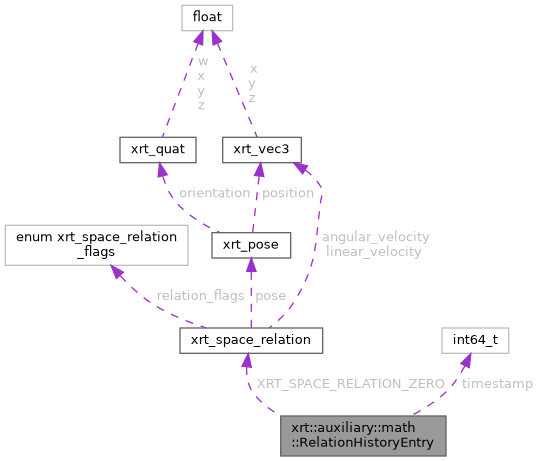
Collaboration diagram for xrt::auxiliary::math::RelationHistoryEntry:
Public Member Functions | |
| RelationHistoryEntry | predict (time_duration_ns delta_ns) const |
| Predicts the relation history entry to the specified delta, returning the new one. | |
| RelationHistoryEntry | interpolate (timepoint_ns to_ns, RelationHistoryEntry successor) const |
| Interpolates between the two relation history entries, returning a new one. | |
| void | estimateMotion (RelationHistoryEntry &in_out_end) const |
| Estimates motion from this relation history to the end entry, modifying the end entry with the new velocities. | |
Data Fields | |
| xrt_space_relation relation | XRT_SPACE_RELATION_ZERO |
| int64_t | timestamp {0} |
Member Function Documentation
◆ estimateMotion()
|
inline |
Estimates motion from this relation history to the end entry, modifying the end entry with the new velocities.
References time_ns_to_s().
◆ interpolate()
|
inline |
Interpolates between the two relation history entries, returning a new one.
- Todo:
- Does interpolating the velocities make any sense?
◆ predict()
|
inline |
Predicts the relation history entry to the specified delta, returning the new one.
References m_predict_relation(), and time_ns_to_s().
The documentation for this struct was generated from the following file:
- auxiliary/math/m_relation_history.hpp
