Generic math helpers for constellation optimizer code. More...
#include "tracking/t_camera_models.hpp"#include "math/m_eigen_interop.hpp"#include "math/m_quatexpmap.hpp"#include "math/m_quatexpmap_bigceres.hpp"#include <Eigen/Core>#include <Eigen/Geometry>#include "ceres/jet.h"#include "ceres/product_manifold.h"#include "ceres/autodiff_manifold.h"#include "ceres/ceres.h"#include "pose_optimize.hpp"#include "math.hpp"#include <ceres/crs_matrix.h>#include <cstring>#include <cmath>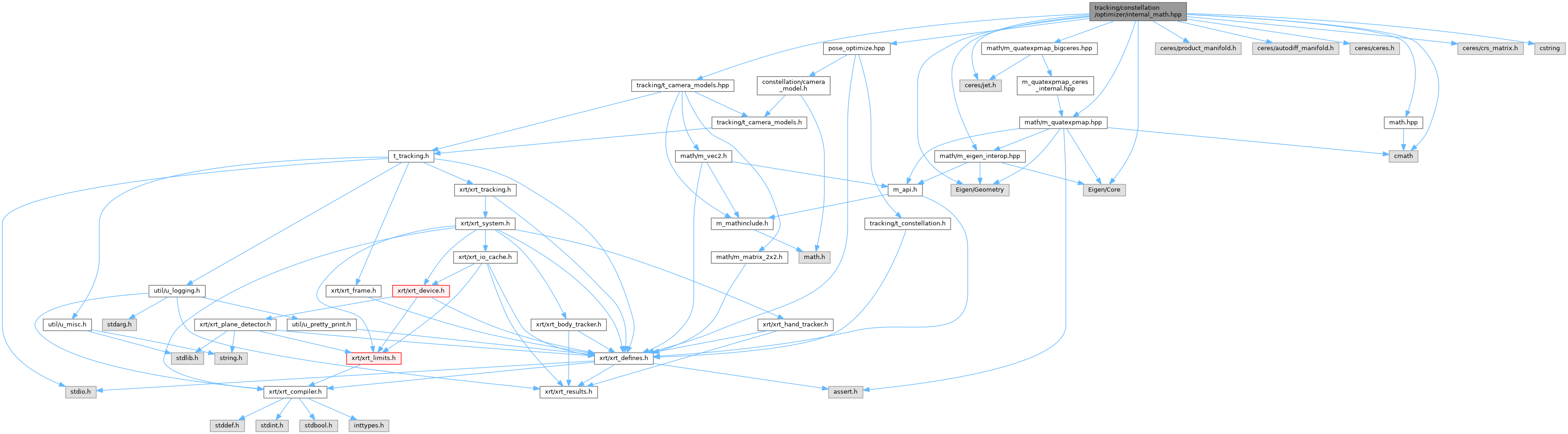
Go to the source code of this file.
Data Structures | |
| struct | xrt::tracking::constellation::optimizer::SeedableVector< T, N > |
| struct | xrt::tracking::constellation::optimizer::WorldGravity< T > |
| The strength of gravity in the world, as a parameter block of its own. More... | |
| struct | xrt::tracking::constellation::optimizer::PitchRoll< T > |
| A parameter block for a camera with 2 degrees of freedom, pitch and roll. Yaw is fixed to 0, and it has no position. More... | |
| struct | xrt::tracking::constellation::optimizer::Pose< T > |
| Pose with 6 degrees of freedom, translation and rotation. More... | |
| struct | xrt::tracking::constellation::optimizer::PoseWithVelocity< T > |
| Pose with 9 degrees of freedom, translation, rotation, and linear velocity. More... | |
| struct | xrt::tracking::constellation::optimizer::ImuExtrinsics< T > |
| struct | xrt::tracking::constellation::optimizer::QuaternionManifoldFunctor |
| Right-multiplying quaternion manifold, matches our local convention. More... | |
Typedefs | |
| typedef Eigen::Matrix< double, kPoseCovarianceSize, kPoseCovarianceSize > | xrt::tracking::constellation::optimizer::PoseStateCovarianceMatrix |
| typedef ceres::AutoDiffManifold< QuaternionManifoldFunctor, 4, 3 > | xrt::tracking::constellation::optimizer::QuaternionManifold |
| Our quaternion manifold functor. | |
| typedef ceres::ProductManifold< ceres::EuclideanManifold< 3 >, QuaternionManifold > | xrt::tracking::constellation::optimizer::PoseManifold |
| Pose manifold, (tX, tY, tZ), (qX, qY, qZ, qW) | |
| typedef ceres::ProductManifold< ceres::EuclideanManifold< 3 >, QuaternionManifold, ceres::EuclideanManifold< 3 > > | xrt::tracking::constellation::optimizer::PoseWithVelocityManifold |
| Pose plus linear velocity, (tX, tY, tZ), (qX, qY, qZ, qW), (vX, vY, vZ). 10 ambient, 9 tangent. | |
Functions | |
| Eigen::Isometry3f | xrt::tracking::constellation::optimizer::isometryFromPose (const xrt_pose &p) |
| Converts an xrt_pose into an Eigen Isometry3f. | |
| static int32_t | xrt::tracking::constellation::optimizer::findLedIndexById (const t_constellation_tracker_led_model *leds_model, t_constellation_led_id_it led_id) |
| Finds a LED in the model by its id. | |
| FactorFitness | xrt::tracking::constellation::optimizer::evaluateFactorFitness (ceres::Problem &problem, const std::vector< ceres::ResidualBlockId > &residual_blocks) |
| Measures how well one kind of factor was fit, at whatever the problem's parameters currently hold. | |
| void | xrt::tracking::constellation::optimizer::matrixCrsToEigen (const ceres::CRSMatrix &mat_crs, Eigen::MatrixXd &mat) |
| Converts a CRS matrix to a dense Eigen matrix. | |
| void | xrt::tracking::constellation::optimizer::marginalize (const VectorXd &residual, const MatrixXd &jacobian, const int num_base_states, VectorXd &out_e0, MatrixXd &out_j) |
Marginalize the first num_base_states states out of the linearized system given by jacobian and residual, handing back the linear prior that replaces them. | |
| template<typename T > | |
| static void | xrt::tracking::constellation::optimizer::project_led (const camera_model ¶ms, const Eigen::Quaternion< T > &Q_cam_model, const Eigen::Vector3< T > &T_cam_model, const Eigen::Vector3< T > &T_model_led, Eigen::Vector2< T > &out_projected_point, T *led_depth_m) |
| template<typename T , typename Derived > | |
| static void | xrt::tracking::constellation::optimizer::computeLedResidual (const camera_model ¶ms, const Eigen::Vector3< T > &T_cam_model, const Eigen::Quaternion< T > &Q_cam_model, const Eigen::Vector2< T > &blob_position_2d, const Eigen::Vector3< T > &T_model_led, Eigen::MatrixBase< Derived > &residual) |
Variables | |
| constexpr bool | xrt::tracking::constellation::optimizer::kOptimizeUndistortedPoints = true |
| Optimize directly on the pre-undistorted points, don't compute residuals in distorted pixel space. | |
| constexpr bool | xrt::tracking::constellation::optimizer::kResidualDebugPrint = false |
| Print debug info about the residuals as we're computing them. | |
| constexpr double | xrt::tracking::constellation::optimizer::kMaxGravity = MATH_GRAVITY_M_S2 * 1.01 |
| constexpr double | xrt::tracking::constellation::optimizer::kMinGravity = MATH_GRAVITY_M_S2 * 0.99 |
| constexpr size_t | xrt::tracking::constellation::optimizer::kMinCorrespondencesPerObservation = 4 |
| Fewer correspondences than this and the observation is dropped. | |
| constexpr double | xrt::tracking::constellation::optimizer::kCameraHuberDeltaSigmas = 3.0 |
| Where a camera observation stops being treated as data and starts being treated as a mistake, in standard deviations. | |
| constexpr int | xrt::tracking::constellation::optimizer::kNumLedResiduals = 2 |
| X and Y in the image, for one LED. | |
| constexpr double | xrt::tracking::constellation::optimizer::kBlobPositionSigmaPixels = 0.16 |
| How well a blob centroid locates the LED that lit it, in pixels. | |
Detailed Description
Generic math helpers for constellation optimizer code.
Typedef Documentation
◆ PoseManifold
| typedef ceres::ProductManifold<ceres::EuclideanManifold<3>, QuaternionManifold> xrt::tracking::constellation::optimizer::PoseManifold |
Pose manifold, (tX, tY, tZ), (qX, qY, qZ, qW)
◆ PoseWithVelocityManifold
| typedef ceres::ProductManifold<ceres::EuclideanManifold<3>, QuaternionManifold, ceres::EuclideanManifold<3> > xrt::tracking::constellation::optimizer::PoseWithVelocityManifold |
Pose plus linear velocity, (tX, tY, tZ), (qX, qY, qZ, qW), (vX, vY, vZ). 10 ambient, 9 tangent.
◆ QuaternionManifold
| typedef ceres::AutoDiffManifold<QuaternionManifoldFunctor, 4, 3> xrt::tracking::constellation::optimizer::QuaternionManifold |
Our quaternion manifold functor.
Function Documentation
◆ evaluateFactorFitness()
| FactorFitness xrt::tracking::constellation::optimizer::evaluateFactorFitness | ( | ceres::Problem & | problem, |
| const std::vector< ceres::ResidualBlockId > & | residual_blocks | ||
| ) |
Measures how well one kind of factor was fit, at whatever the problem's parameters currently hold.
Both factor types are whitened, so this is directly comparable between them and against 1.
- Parameters
-
problem The problem, evaluated at its current parameter values. residual_blocks The blocks belonging to this kind of factor.
References xrt::tracking::constellation::optimizer::evaluateFactorFitness(), and xrt::tracking::constellation::optimizer::FactorFitness::num_residuals.
Referenced by xrt::tracking::constellation::optimizer::evaluateFactorFitness().
◆ findLedIndexById()
|
inlinestatic |
Finds a LED in the model by its id.
A LED's id is an opaque identifier chosen by the driver, not its position in the model: drivers are free to derive it from device-specific numbering (the Rift uses the headset's own LED indices, which include a slot for the IMU). So a blob's matched_device_led_id has to be resolved through here rather than used as an index.
- Returns
- The index of the LED in the model, or -1 when no LED carries that id.
References xrt::tracking::constellation::optimizer::findLedIndexById(), t_constellation_tracker_led::id, t_constellation_tracker_led_model::led_count, and t_constellation_tracker_led_model::leds.
Referenced by xrt::tracking::constellation::optimizer::findLedIndexById().
◆ isometryFromPose()
|
inline |
Converts an xrt_pose into an Eigen Isometry3f.
References xrt::tracking::constellation::optimizer::isometryFromPose(), xrt::auxiliary::math::map_quat(), and xrt::auxiliary::math::map_vec3().
Referenced by xrt::tracking::constellation::optimizer::isometryFromPose().
◆ marginalize()
| void xrt::tracking::constellation::optimizer::marginalize | ( | const VectorXd & | residual, |
| const MatrixXd & | jacobian, | ||
| const int | num_base_states, | ||
| VectorXd & | out_e0, | ||
| MatrixXd & | out_j | ||
| ) |
Marginalize the first num_base_states states out of the linearized system given by jacobian and residual, handing back the linear prior that replaces them.
Inspired/specialized from MarginalizationError::marginalizeOut() from OKVIS.
References xrt::tracking::constellation::optimizer::marginalize(), and xrt::tracking::constellation::optimizer::robustComputeSqrtAndPinvSqrt().
Referenced by xrt::tracking::constellation::optimizer::marginalize().
◆ matrixCrsToEigen()
| void xrt::tracking::constellation::optimizer::matrixCrsToEigen | ( | const ceres::CRSMatrix & | mat_crs, |
| Eigen::MatrixXd & | mat | ||
| ) |
Converts a CRS matrix to a dense Eigen matrix.
References xrt::tracking::constellation::optimizer::matrixCrsToEigen().
Referenced by xrt::tracking::constellation::optimizer::matrixCrsToEigen().
Variable Documentation
◆ kBlobPositionSigmaPixels
|
constexpr |
How well a blob centroid locates the LED that lit it, in pixels.
The camera residuals are reprojection errors, so they are only comparable to the whitened IMU residuals once they are divided by the noise that produced them. This is the same floor the per-frame PnP puts on its own residual sigma, since a blob has about this much pixels of noise, at least on CV1.
◆ kCameraHuberDeltaSigmas
|
constexpr |
Where a camera observation stops being treated as data and starts being treated as a mistake, in standard deviations.
Used to size the Huber loss function.
The loss is applied to a whole observation rather than to each LED of it, so this is measured against the spread of the observation's chi-square rather than against a single reprojection error, and the threshold it produces grows with the number of correspondences.
◆ kMinCorrespondencesPerObservation
|
constexpr |
Fewer correspondences than this and the observation is dropped.
Any less and this is likely a degenerate solve.
Referenced by xrt::tracking::constellation::optimizer::rig_calibration::RigCalibration::pushCameraSample().
◆ kNumLedResiduals
|
constexpr |
X and Y in the image, for one LED.
◆ kOptimizeUndistortedPoints
|
constexpr |
Optimize directly on the pre-undistorted points, don't compute residuals in distorted pixel space.
We don't have a "project" routine for the CV1 distortion algorithm, so we work in undistorted space, instead.
Referenced by xrt::tracking::constellation::optimizer::rig_calibration::RigCalibration::pushCameraSample().
◆ kResidualDebugPrint
|
constexpr |
Print debug info about the residuals as we're computing them.
